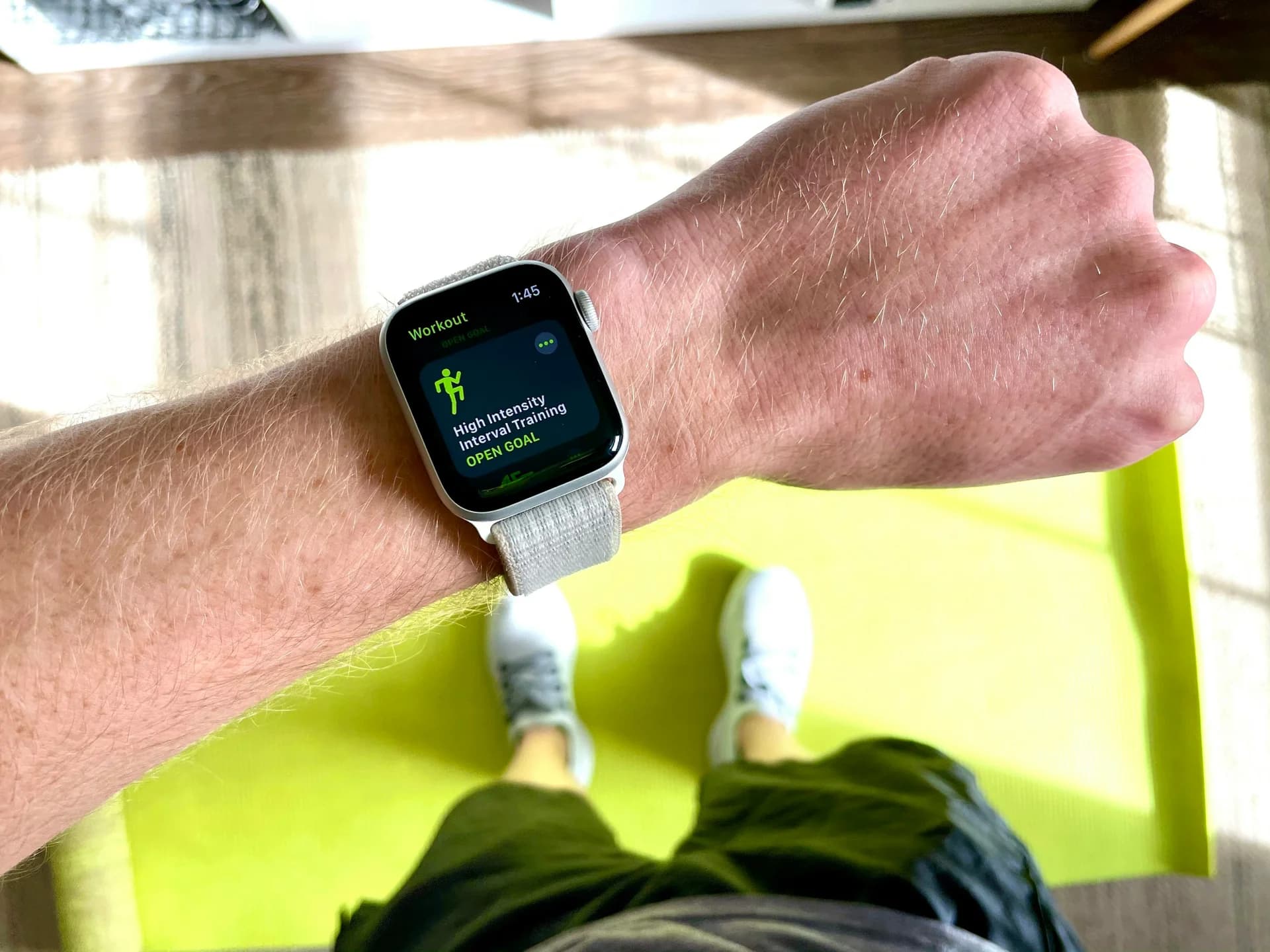
You finish a workout, glance at your wrist, and there it is: 480 calories. The number looks precise, almost like an accounting entry. It isn't. Your watch never measured a single calorie. It made a prediction, and a study published this summer shows that prediction gets worse the more body fat the wearer has.
That's no reason to ditch your watch. It is a reason to learn how to read that number, and above all, what not to do with it.
What your watch measures, and what it guesses
Your wrist gives the watch two real signals. The accelerometer records your movement. The optical sensor shines light into your skin and tracks what bounces back: blood absorbs light, and the changes in that reflection let the watch estimate your heart rate.
Energy expenditure is a different story. You can't see it from the wrist. To actually measure it, labs use indirect calorimetry: a mask that analyzes how much oxygen you take in and how much carbon dioxide you breathe out. Your watch has none of that. It combines movement and pulse with what it knows about you, and an algorithm turns all of it into a calorie count.
Apple says so plainly in its own documentation: your height, weight, gender, and age are among the things your watch uses to calculate how many calories you burn. In other words, two people doing the exact same workout at the same heart rate will get different totals if their profiles differ.
Jason Kostrna, a researcher at Florida International University, sums up the problem in a piece published on September 21, 2026 in The Conversation: the watch relies on signals it can measure reasonably well to predict something it can't measure directly. And body composition, fitness, movement efficiency, and the way your body responds to exercise all vary from person to person. Every one of those affects the prediction.
The 2026 study: four watches versus a gas analyzer
Kostrna's team published its results on July 29, 2026 in PLOS One. The setup is simple and easy to replicate:
- 58 adults recruited in Miami, with an average age of 23 and a wide range of body fat levels and skin tones;
- four watches worn at the same time: Apple Watch Series 8, Fitbit Sense 2, Samsung Galaxy Watch 5, and Garmin Forerunner 955;
- ten minutes on a recumbent bike, alternating two-minute intervals of moderate and vigorous effort, bracketed by five minutes of rest and five of recovery;
- a lab-grade reference: a COSMED K5 portable metabolic analyzer, which measures the gases you breathe.
The verdict is clear. Across all four watches, the median error, expressed as a share of true energy expenditure, landed at roughly 15% to 25%. And it wasn't random noise: three of the four watches showed a significant average bias, all in the same direction.
Who overestimates, and by how much
On this short protocol, the average bias, meaning the gap between the watch and the analyzer, looked like this:
- Garmin: +68.6 calories on average;
- Samsung: +56.8 calories;
- Apple: +21.6 calories;
- Fitbit: +3.1 calories, but that flattering number is misleading.
Why misleading? Because the Fitbit produced seven implausible estimates, each more than 450% of the reference value, or about 13% of its trials. The researchers left them out when computing the average. Put them back in and the Fitbit's bias jumps to 128.6 calories, by far the worst of the four. An average close to zero can hide a watch that's often way off, in both directions.
These numbers apply to one model per brand, on this protocol, in this group of people. They are not a definitive ranking of brands, and the authors don't present them as one.
The uncomfortable finding: body fat
The study's main contribution lies elsewhere. The higher the body fat percentage, the bigger the error, on all four watches, with a steeper climb for Fitbit and Garmin. The bias also tilted further toward overestimation as body fat went up.
Kostrna draws a practical conclusion worth reading twice. If your body fat is 35% or higher and you exercise four hours a week, your watch could be off by 1,200 to 2,400 calories over the week. That's close to a full day's worth of food, counted as "burned" when it wasn't.
The irony is hard to miss: the people who lean on this number the most to manage their weight are exactly the ones for whom it's least reliable.
What about skin tone?
That was the study's other question. Optical sensors are known to be sensitive to skin pigmentation. Here, the researchers found no measurable effect of skin tone across Fitzpatrick types III to V. That result is limited to those skin types and this protocol: it says nothing about the lightest or darkest skin tones.
An old problem, not a 2026 glitch
If these numbers surprise you, they aren't new. Back in 2017, a Stanford team led by Anna Shcherbina tested seven wrist-worn devices on 60 participants while sitting, walking, running, and cycling. Their results, published in the Journal of Personalized Medicine, already showed the same contrast:
- for heart rate, six of the seven devices stayed under a 5% median error while cycling;
- for energy expenditure, not a single device got below 20% error. Median error ranged from 27.4% for the best (Fitbit Surge) to 92.6% for the worst (PulseOn).
The Stanford study also found larger errors in men, in people with a higher BMI, and in people with darker skin. That last point differs from the 2026 finding, which used other devices and a different protocol, so the question isn't settled for every watch.
A meta-analysis published in the British Journal of Sports Medicine zoomed out further, pooling 60 studies and 104 comparisons. Its conclusion: accuracy depends heavily on the type of activity, and results vary enormously from one study to the next. One encouraging note: adding heart rate, or a heat sensor, to the accelerometer reduced the error in most activities.
So the big picture has held for nearly a decade: your watch is pretty good at your pulse and rough on your calories. It's the same logic that applies to blood pressure readings from the wrist: the more a value is inferred rather than sensed, the more carefully you should read it.
What a 20% error means in real life
A percentage stays abstract. Take a workout your watch rates at 500 calories. With a 15% to 25% error, your actual burn could be 75 to 125 calories away from that number. For a single session, that's small. But this kind of error has a catch: when it always points the same way, it doesn't cancel out. It adds up.
That's exactly the trap of the consistent overestimation seen in three of the four watches. If you "eat back" the calories your watch shows every evening, the whole error lands on your plate. And you won't see it on the screen, because the screen is where the error comes from.
How to use the number anyway
The authors don't conclude that watches are useless. Kostrna points out that workout duration, distance, and pace are still useful. His recommendation is to treat the calorie number as an estimate rather than an exact measurement. Here's how to put that into practice.
1. Compare yourself to yourself, never to others
A watch that overestimates by 20% will probably do so fairly consistently for you. The absolute total is wrong, but the difference between your Monday and Thursday sessions carries more meaning. The study's authors actually flag within-person tracking over time as something worth studying, without having proven it.
2. Don't switch watches midstream
Garmin, Samsung, Apple, and Fitbit don't get it wrong in the same way. Switching brands can create a jump of dozens of calories per session that reflects no real change. If you change devices, treat your calorie history as starting over.
3. Keep your profile current and calibrate
Since height, weight, gender, and age feed the calculation, a weight setting stuck where it was two years ago skews the result. Apple also notes that calibration, which means walking or running outdoors with a good GPS signal, can improve the accuracy of calorie calculations.
4. Cross-check with a sturdier signal
To judge your energy balance, the most telling signal is still how your weight trends over several weeks, not your watch's counter. Connecting a smart scale, for example through Kantise's Withings integration, lets you see whether your weight trend backs up what your watch is telling you. If the watch reports a big deficit and your weight doesn't budge, the watch is the likely culprit.
5. Let your pulse guide the effort
If your goal is to get fitter rather than to count, heart rate is the better guide: it's your watch's most reliable measurement. Your resting heart rate says a lot about your fitness, and heart rate zones structure training far better than a calorie total. It's the approach we take to help you train smarter as an amateur runner.
What the study doesn't tell us
A few honest limitations, several of them flagged by the authors themselves. The protocol lasted only about twenty minutes, on a bike, and the watches kept recording through the rest phases. Participants wore several watches at once, which can affect how snugly each band fits. The group, young and Hispanic, doesn't represent everyone. And the study says nothing about running, strength training, or expenditure across a full day.
None of this overturns the conclusion. It's a reminder that we don't yet know the exact size of the error in your particular case. All the more reason not to build your eating decisions on that number.
FAQ
Does my smartwatch actually measure calories burned?
No. It measures your movement and heart rate, then estimates expenditure using an algorithm and your profile (height, weight, gender, age). Only lab calorimetry actually measures energy expenditure.
How far off are smartwatch calorie counts?
In the 2026 PLOS One study, the median error of the four watches tested was roughly 15% to 25%. In 2017, the Stanford study found no device under 20% error, with median errors as high as 92.6%.
Do watches overestimate or underestimate calories?
In the 2026 study, three of the four watches overestimated expenditure on average, Garmin and Samsung more than Apple. The Fitbit's average bias was close to zero, but only after seven implausible readings were removed.
Why does body fat throw off the calculation?
The study documents the link without explaining it definitively. The authors point to differences in hemodynamics, body composition, and movement efficiency, along with algorithms calibrated on populations where people with higher body fat are underrepresented.
Should I eat back the calories my watch shows after a workout?
Carefully. The study's author recommends being conservative before using that number to decide how much to eat. Your weight trend over several weeks is a more reliable guide than any single session's total.
Ready to connect what your watch says with what your scale shows? Kantise brings your data together in one place so you can watch the trends instead of trusting a single number.
Sources
- Kostrna J., Oparina E., Palacios C., Rodriguez A. J., Pei J., Ajmal A., Ramella-Roman J. C. (2026). Body fat, skin tone, and the accuracy of smartwatch caloric expenditure estimates. PLOS One, 21(7), e0353261.
- Kostrna J. (2026). The higher your body fat percentage, the less accurate your smartwatch is at measuring calories you burn when exercising. The Conversation, September 21, 2026.
- Shcherbina A., Mattsson C. M., Waggott D. et al. (2017). Accuracy in Wrist-Worn, Sensor-Based Measurements of Heart Rate and Energy Expenditure in a Diverse Cohort. Journal of Personalized Medicine, 7(2), 3.
- O'Driscoll R., Turicchi J., Beaulieu K. et al. (2020). How well do activity monitors estimate energy expenditure? A systematic review and meta-analysis of the validity of current technologies. British Journal of Sports Medicine, 54(6), 332-340.
- Apple. Calibrate your Apple Watch for improved Workout and Activity accuracy. Apple Support.
Kantise is an observation tool, not a medical device. The information in this article does not replace advice from a healthcare professional or registered dietitian.