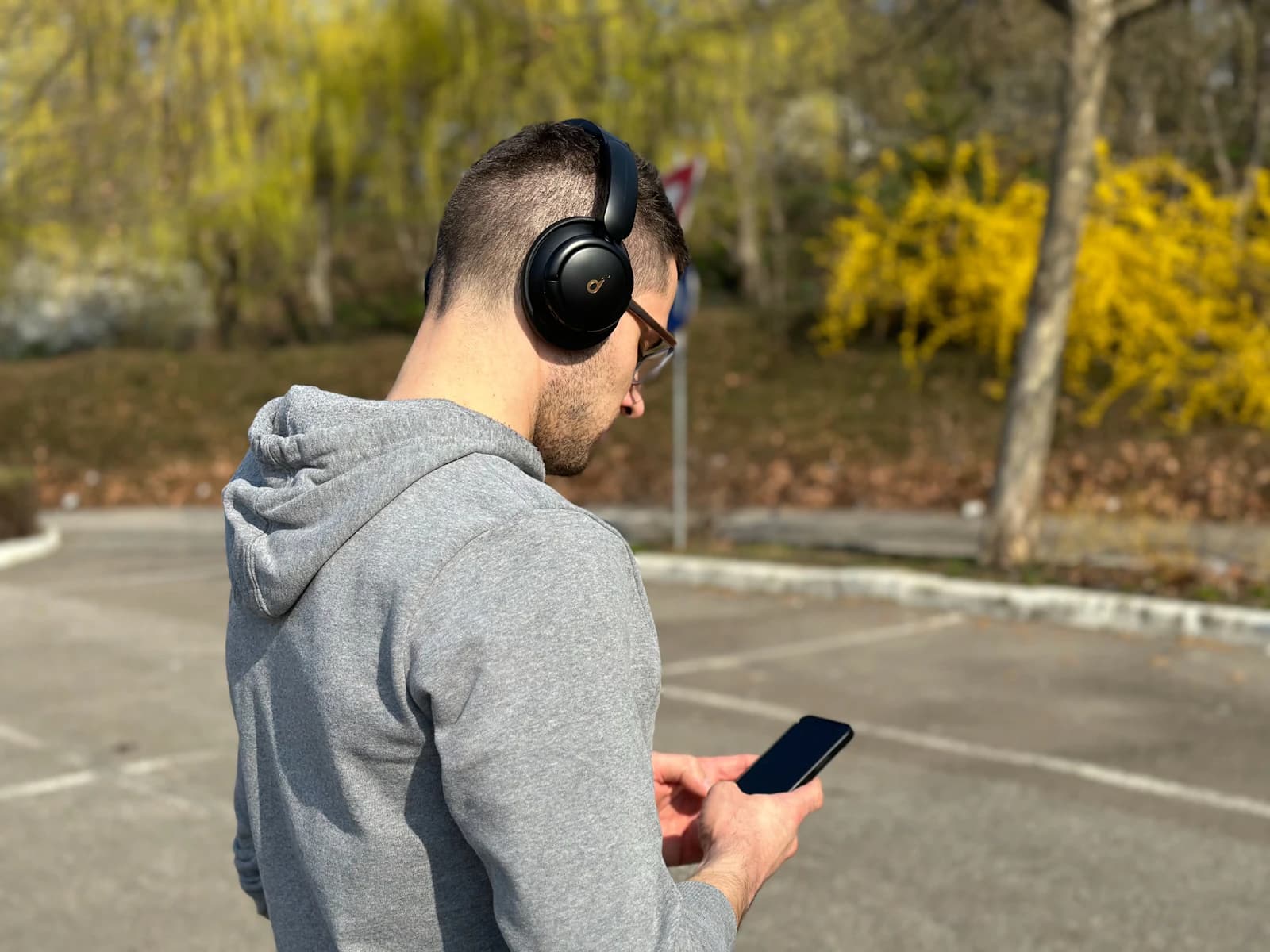
Slipping on your headphones before a workout is more than a comfort habit. In March 2026, a team at the University of Jyväskylä published a study in Psychology of Sport & Exercise with a telling title: "Feel the beat, not the burn." Its conclusion is clear and quantified: listening to music you choose yourself lets you pedal noticeably longer before exhaustion, without the effort feeling any harder. Why does that deserve attention? And what does three decades of accumulated research actually say about the workout playlist?
A 2026 study puts a number on the intuition
The experiment, led by Andrew Danso and colleagues, followed 29 physically active adults during a cycling test to exhaustion, at about 80% of their peak power. With self-selected music, average exercise time reached 35.6 minutes, compared to 29.8 minutes in silence — nearly six extra minutes, an endurance gain of roughly 20%.
The most interesting detail lies elsewhere. At the point of quitting, heart rate and blood lactate levels were comparable in both conditions. In other words, participants did not push themselves further "into the red" physiologically; they simply tolerated the same level of discomfort for longer. Most of the chosen tracks fell in a tempo range of 120 to 140 beats per minute — an interval that recurs with striking regularity across the literature.
Why music pushes back the moment you give up
The main mechanism has a name: dissociation. During submaximal effort, the brain receives a constant stream of fatigue signals — heavy legs, breathing, heat. Music occupies part of the available attention and turns the inner gaze away from those sensations. The result: at equal physiological intensity, perceived effort drops.
This effect is no trivial matter. The landmark synthesis by Costas Karageorghis and David-Lee Priest reports that well-chosen background music can cut perceived exertion by about 10% at low-to-moderate intensities. A second mechanism kicks in when the track's beat matches the movement: auditory-motor coupling. The nervous system spontaneously syncs stride or pedal cadence to the musical pulse, making the movement more economical and steadier.
The tempo that matters: around 120-140 BPM
If there is one setting worth remembering, this is it. The Karageorghis and Priest review recommends a range of 125 to 140 beats per minute for intensities matching 40-90% of maximum heart rate. Below that, the track drags; above it, the benefit plateaus, because the body cannot keep accelerating its cadence to follow the music indefinitely.
The distinction between two uses sharpens the picture. Asynchronous music acts as a backdrop, with no explicit lock to the movement. Synchronous music, by contrast, works like a metronome: you deliberately align your steps or pedal strokes with the tempo. The latter produces the strongest effects. In a treadmill study cited by the same synthesis, motivational synchronous music drove a 15% rise in endurance compared to silence.
What the field's largest meta-analysis confirms
The 2026 study did not appear out of nowhere. It sits within a body of evidence consolidated by a landmark 2020 meta-analysis. Peter Terry, Costas Karageorghis and colleagues reviewed 139 studies and 3,599 participants in Psychological Bulletin. Their conclusion: music exerts a significant beneficial effect on four families of outcomes — psychological responses (mood, motivation), perceived exertion, physical performance, and physiological efficiency, including oxygen consumption.
That breadth is what separates the topic from a mere gym belief. Few free training "tricks" — no gear, no side effects — rest on such a wide evidence base. An earlier 2017 study had observed that with self-chosen music, total exercise time climbed from 22.5 to 37.1 minutes on average, while also noting that the relationship between tempo and heart rate varied from one person to the next.

Building a playlist that works
Several practical lessons emerge from this body of work:
- Pick your own tracks. The 2026 study used songs selected by the participants, not an imposed playlist. Personal preference and the memories tied to a song amplify its motivating power.
- Match the tempo to the target intensity. For an endurance ride, aim for 120-140 BPM. For brisk walking, drop toward 115-125; for short intervals, the tempo benefit fades in favor of the track's overall energy.
- Use music as a metronome. Locking your stride to the pulse (synchronous use) delivers the clearest gains and smooths your pace.
- Save it for the right moments. The benefit peaks at low-to-moderate intensity. Near maximal effort, internal physiological signals take over and music can do little.
One question few apps ask: which music actually accompanies your best sessions? Cross-referencing your listening history with your training and heart-rate data reveals the tracks, tempos, or moods that line up with your strongest outings. That is exactly the kind of cross-habit correlation a platform like Kantise enables — you can explore its features or get the broader picture on the homepage. More analyses on performance and wellbeing are collected on the blog.
One limit to keep in mind
Music is no universal performance enhancer. Its effect is primarily psychological: it does not make muscles stronger, it shifts the threshold of tolerance for discomfort. Outdoors, it also dulls awareness — keeping one earbud out in the city or on the road remains common sense. And in highly trained athletes working at high intensity, the gain shrinks, because the body is mostly listening to its own signals by then. For the vast majority of exercisers, however, the right playlist remains one of the simplest and best-documented levers for going a little further.
FAQ
How much does music really improve endurance?
The 2026 University of Jyväskylä study measured about a 20% improvement in time to exhaustion on a bike (35.6 minutes with music versus 29.8 in silence), with no rise in perceived effort or in physiological markers at the point of quitting.
What tempo (BPM) should you choose for training?
The Karageorghis and Priest review recommends a range of 125 to 140 beats per minute for intensities between 40 and 90% of maximum heart rate. Above that, the benefit plateaus because the body's cadence cannot keep following indefinitely.
Why does effort feel easier with music?
Through dissociation: music captures part of your attention and turns the brain away from fatigue signals. At low-to-moderate intensities, this cuts perceived effort by about 10%. Auditory-motor coupling adds to it when movement locks onto the beat.
Is it better to choose your own music or follow a ready-made playlist?
Self-selected tracks work better. The 2026 study relied on personal selection, and the literature stresses that preference and the memories tied to a song strengthen its motivating power beyond tempo alone.
Does music help during very intense effort too?
Much less. As you approach maximal intensity, internal physiological signals (breathlessness, muscle acidity) dominate attention and music can no longer mask them. Its benefit is clearest at low-to-moderate intensities.