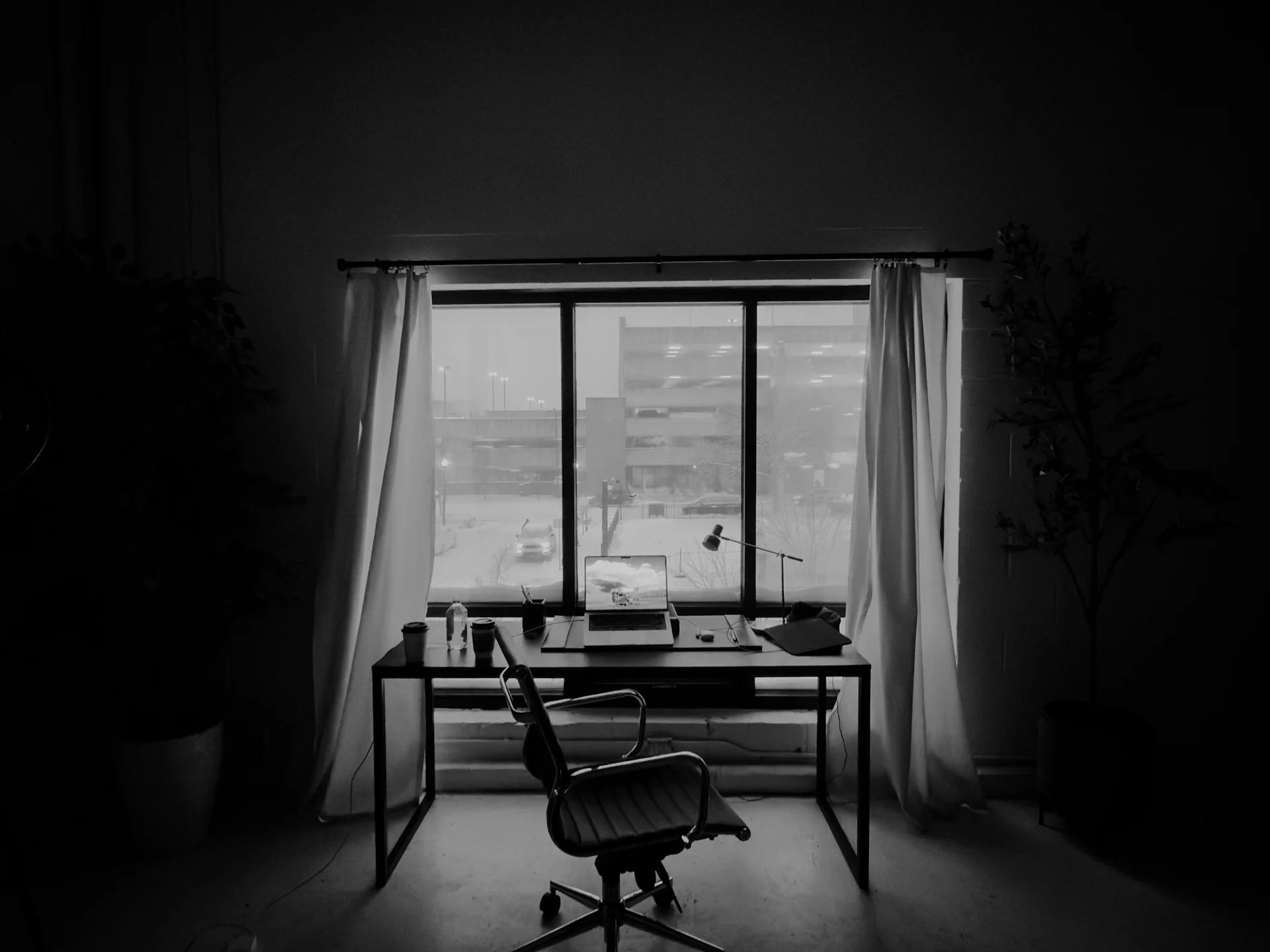
Everyone knows the scene: the desk lamp still on at 3 a.m., the flashcards going round one last time, one coffee too many. That night before the exam feels decisive. It isn't.
In 2019, an MIT team tracked 88 first-year students wearing activity monitors across an entire semester of introductory chemistry. The most counterintuitive finding: sleep on the night immediately before each of the three midterms showed no significant correlation with the score. What predicted performance was sleep across the month and the week beforehand (Okano et al., 2019).
Your grade is decided during the study weeks, not during the all-nighter. That shifts the question entirely. It stops being "how do I survive until the exam" and becomes "what does a week look like that I can repeat four times without falling apart?"
The problem is not the hour count
A study week is almost always designed as a sprint. Stack the hours, push back bedtime, cut everything else. The logic sounds airtight: more hours, more material covered. It ignores two things the research has documented for decades.
First: the same amount of study time produces very different results depending on how you spread it. Second: you are a poor judge of your own condition. Those two combine in the worst possible way, and that combination is exactly what turns a study period into exhaustion.
Spacing beats stacking, and the gap is measurable
This is one of the best-established effects in learning psychology. The landmark synthesis by Cepeda and colleagues (2006), published in Psychological Bulletin, pooled 839 assessments from 317 experiments across 184 articles. Its conclusion fits in a sentence: separating study episodes by at least a day, rather than cramming everything into one session, substantially improves long-term retention. Across the studies with retention intervals longer than a month, the average benefit of spaced over massed study was 15%.
A more recent meta-analysis, this time limited to real classrooms rather than the lab, finds the same effect. Mawson and Kang (2025) report a d of 0.54 across 22 studies and 31 effect sizes, with more than 3,000 participants. A moderate effect — but obtained at equal study time. That detail is the whole point: spacing does not ask you to work more, only to slice differently.
Cepeda's most useful result, though, is elsewhere. The optimal interval between two passes over the same material grows with the deadline. For an exam six months out, reviewing a chapter daily is inefficient; for a quiz next week, spacing it a month apart is absurd. The practical rule: the further away the exam, the further apart your passes can — and should — be.
Concretely, a month out: three one-hour passes over a chapter, placed in three different weeks, beat three consecutive hours on a single evening. Same cost, better return.

Sleep regularity matters as much as sleep length
Back to the MIT study. Sleep measures alone accounted for nearly 25% of the variance in academic performance. The breakdown is worth reading closely: duration contributed 7.16%, quality 9.68%, and consistency 7.6%.
That last one is what study schedules ignore most reliably. Students whose nightly sleep duration varied the most scored worse (r = −0.36), independently of their average sleep. Going to bed at midnight every night beats 10 p.m. one night and 3 a.m. the next, even when the weekly total is identical.
For scale: participants averaged 7 hours 8 minutes a night. These were not students sleeping luxuriously. The ones who slept steadily simply did better.
The trap: you cannot feel your own decline
This is where common sense fails outright. In a now-classic experiment, Van Dongen and colleagues (2003) assigned adults to 4, 6 or 8 hours in bed per night for fourteen consecutive days. After two weeks at 6 hours, the restricted group's cognitive deficits were equivalent to up to two full nights of total sleep deprivation.
The genuinely unsettling result is the second one. Participants' subjective sleepiness rose for the first few days, then leveled off. Their measured performance kept declining, day after day, with no plateau. They believed they had adapted. They had not.
That is precisely the state of a third study week running on six hours. The feeling says "I'm fine, I've got this." The curve says something else. And because no internal alarm ever goes off, nothing corrects the trajectory.
This is also the only honest reason to measure anything during exam season: not to optimize, but because subjective perception has been demonstrated to fail on exactly this point. In Kantise, two series are enough — your bedtime, and the number of study blocks you actually completed. It is the approach we lay out in our guide to studying effectively without burning out.
Student burnout, without inflating the numbers
Figures on student exhaustion circulate widely and are rarely sourced. A meta-analysis published in PLoS One by Kaggwa and colleagues (2021) pooled 55 studies covering 27,940 university students. Full burnout prevalence came out at 12.1%. Taken separately, its three dimensions are considerably more common: 27.8% for emotional exhaustion, 32.6% for cynicism, 29.9% for reduced professional efficacy.
One honest caveat: that meta-analysis covers low- and middle-income countries. It does not transfer directly to a student in Boston or Berlin. What it does establish solidly is that academic exhaustion is not a marginal phenomenon — and that its dimensions show up long before full burnout does. You can be cynically detached from your own coursework without being burned out. That is already a signal.
What a week that holds actually looks like
There is no universal hour count, and you should distrust anyone offering one. What follows is not a schedule to copy, but four principles the evidence above genuinely supports.
- A fixed sleep window, held every day, weekends included. This is the one parameter where regularity pays as much as quantity. Pick a bedtime you can keep on a Wednesday and on a Saturday alike.
- Each subject revisited on separate days, never in one block. Three spaced passes beat one long session at equal time. The further off the exam, the wider you can space them.
- Short work blocks with real breaks. Not breaks spent scrolling: attention restoration requires switching mode, not just switching content. We covered that mechanism in our article on micro-breaks and cognitive recovery.
- One genuinely free half-day per week. Not as a reward, but as the condition for the next three weeks to look like this one.
A word about the schedule itself. The tendency to systematically underestimate how long each task will take has a name — the planning fallacy — and every study schedule is subject to it. A plan that budgets eight productive hours a day is not ambitious, it is wrong — and its daily failure feeds precisely the guilt-and-avoidance cycle described in our article on the brain mechanisms behind procrastination.
So plan less than you think you can do. A schedule kept at 100% for four weeks beats an ambitious one kept at 50% for ten days and then dropped.
What this evidence does not say
Three caveats, because they matter. The MIT study covers 88 students in one specific science course: the correlations observed are not laws. Mawson and Kang report high heterogeneity (I² = 92.13%), meaning the spacing effect varies considerably across contexts. And sleep-restriction protocols like Van Dongen's measure group averages: they describe a tendency, not your particular case.
None of this cancels the overall direction. It simply means the right protocol is the one you verify against your own data, not the one an article prescribes. Students preparing for something like the MCAT or another months-long medical exam are, incidentally, the ones for whom the gap between the two approaches widens the most.
FAQ
Should I sleep the night before an exam?
Yes, but that is not where your grade is decided. In Okano et al. (2019), sleep on the single night before the exam showed no correlation with results, while sleep across the preceding month and week did. Sleeping well the night before remains worthwhile; it simply does not make up for three irregular weeks.
How many hours a day should I study?
No solid study sets a universal number, and the figures that circulate ("six hours", "eight hours") rest on nothing verifiable. The literature is clear about distribution, however: at equal time, spreading your passes across several days outperforms concentrating them. Set your volume at whatever you can repeat for four straight weeks.
Is six hours of sleep sustainable during exam season?
Van Dongen et al. (2003) measured that after fourteen nights at six hours, cognitive deficits matched up to two full nights of total sleep deprivation. The critical part: participants did not notice, because their subjective sleepiness had leveled off while their performance kept dropping. The feeling of "holding up" is not a reliable indicator.
Is it better to go deep on one subject or alternate?
Alternate, provided you return to each topic several times. The benefit of spaced over massed study averaged 15% in the studies with retention intervals beyond a month reviewed by Cepeda et al. (2006). The ideal interval grows with the distance to the exam: the further off it is, the wider your passes can be spaced.
How do I know if I am sliding toward exhaustion?
Full burnout stays in the minority — 12.1% in the Kaggwa et al. (2021) meta-analysis — but its dimensions appear far earlier and far more often: emotional exhaustion, cynicism toward your studies, a sense of ineffectiveness. A sleep window drifting night after night, and work blocks honored less and less often, are two signals you can observe without any questionnaire. If doubt persists, talk to your institution's health services.
Ready to see what your weeks are telling you?
You do not need a complex dashboard to get through exam season. Two series are enough: your sleep window, and the study blocks you actually completed. After three weeks, the curve will tell you what no feeling can — whether your week is holding, or quietly eroding while you believe you have adapted.
Sources
- Okano, K., Kaczmarzyk, J. R., Dave, N., Gabrieli, J. D. E., & Grossman, J. C. (2019). Sleep quality, duration, and consistency are associated with better academic performance in college students. npj Science of Learning. Read
- Cepeda, N. J., Pashler, H., Vul, E., Wixted, J. T., & Rohrer, D. (2006). Distributed Practice in Verbal Recall Tasks: A Review and Quantitative Synthesis. Psychological Bulletin, 132(3), 354-380. Read
- Mawson, M., & Kang, S. H. K. (2025). The Distributed Practice Effect on Classroom Learning: A Meta-Analytic Review of Applied Research. Behavioral Sciences. Read
- Van Dongen, H. P. A., Maislin, G., Mullington, J. M., & Dinges, D. F. (2003). The cumulative cost of additional wakefulness: dose-response effects on neurobehavioral functions and sleep physiology from chronic sleep restriction and total sleep deprivation. Sleep, 26(2), 117-126. Read
- Kaggwa, M. M., Kajjimu, J., Sserunkuma, J., et al. (2021). Prevalence of burnout among university students in low- and middle-income countries: A systematic review and meta-analysis. PLoS One. Read
Kantise is an observation tool, not a medical device. The information in this article is provided for general purposes and does not replace the advice of a healthcare professional.