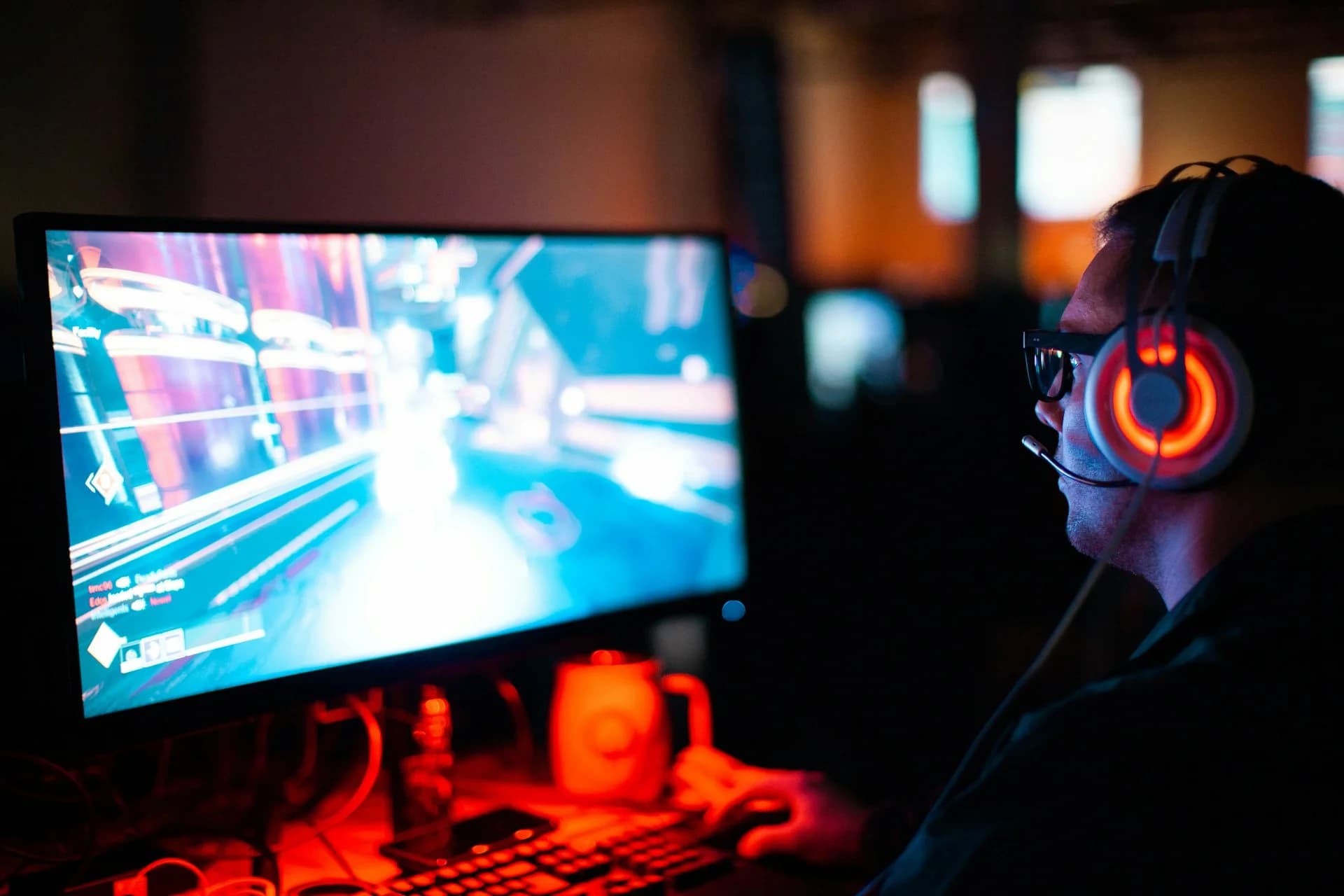
From July 6 to August 23, 2026, Paris is hosting the Esports World Cup, the largest competitive gaming festival ever staged: twenty-five tournaments, twenty-four titles, more than 2,000 players, and a prize pool topping 75 million dollars. On stage, athletes spot an opponent and pull the trigger before spectators have grasped what just happened. Their most valuable weapon is invisible — reaction time, the sliver of a second between a signal and the movement it triggers. And that same number, measured in you, says a great deal about something other than your gaming skill: the health of your brain.
175 milliseconds: the pros' tempo
How long does it take an elite player to react? A 2021 study in The Ohio Journal of Science compared three groups of young adults aged 18 to 22: esports competitors, American football players, and a non-athletic control group. The gamers logged an average reaction time of 175 milliseconds, edging out the footballers (187 ms) and clearly beating the non-competitors. For reference, a typical adult's simple visual reaction time usually sits around 250 milliseconds.
The sample was small — about a dozen participants per group — and these findings await confirmation at larger scale. But the trend echoes other work: intensive action-game players process visual information faster and commit to motor decisions a beat ahead. In competition, the gap widens further thanks to anticipation: a professional almost never reacts "from cold." They pre-aim at the angles where an enemy is likely to appear, which shortens their effective response well below their raw test score.
What a reaction time actually measures
Behind that single number lie several distinct operations. Researchers separate simple reaction time — pressing the moment a light appears — from choice reaction time, where you must first identify the correct signal among several before acting. The latter leans more heavily on attention, perception, and decision-making. It is precisely on these choice tasks that the most seasoned players pull ahead, a sign that their edge is not just fast fingers but more efficient brain processing.
Reaction time is, in effect, a gauge of the nervous system's information-processing speed. It depends on how quickly a signal travels from the eye to the brain, is interpreted there, and is relayed back to the muscles. That speed is not fixed: it peaks in young adulthood, then declines gradually with age. Past your thirties, each decade adds a few milliseconds, and the slowdown accelerates noticeably after 60. It is one reason esports careers, like those in many elite sports, tend to be short.
A mirror of brain health
Here is where the story turns fascinating: this performance marker is also a health marker. Because it reflects the overall integrity of the nervous system, reaction time has been linked, in large population studies, to longevity itself.
In 2014, a team of researchers including psychologist Ian Deary drew on the American NHANES-III survey, following more than 5,100 adults for roughly fifteen years. The results, published in PLOS ONE, were striking: for each step slower in reaction time, the risk of death from all causes rose by about 25%, and cardiovascular mortality by 36%. The link held after adjusting for age, sex, and various health factors. A slow reaction time is obviously not a cause of death, but a quiet readout of the body's general state.
Consistency matters more than speed
More surprising still: it is not only slowness that raises concern, but inconsistency. When reaction time is measured repeatedly, some people post very stable scores while others swing between quick responses and unpredictable lags. This trial-to-trial variability is seen as a marker of "noise" in brain function. An Australian study of older adults, reported in 2017, found that people with the most variable reaction times faced a markedly higher risk of death in later years — independent of their overall cognitive level and even of any emerging dementia. In the NHANES analysis, this variability in fact weighed more heavily than average slowness.
Can you improve your reaction time?
The good news is that this parameter is not entirely set in stone. Targeted training — repeating a reaction task — improves performance on that task, as the dramatic gains of dedicated players show. Whether that gain transfers to everyday life is less well established.
What does protect processing speed over the years are the same levers that protect the brain in general: sufficient, regular sleep, aerobic activity, good cardiovascular fitness, and limiting the factors that damage blood vessels. Conversely, fatigue, alcohol, and sleep loss degrade reaction time within hours — an effect every late-night gamer knows intuitively, and one that driving research has documented for decades.
For anyone curious about their own data, reaction time has a rare virtue: it is simple to measure, numeric, and sensitive to lifestyle. Tracked over time, it becomes one signal among others — alongside sleep, resting heart rate, or activity — whose value comes from cross-referencing. That is the logic behind Kantise: connecting these scattered indicators to spot what actually moves the needle for you. Does a short night blunt your reflexes the next day? Do your best days follow more movement the evening before? More science-based analyses are gathered on our blog, with a broader overview on the homepage.
Ultimately, the Esports World Cup stage and the neurologist's office measure the same thing from opposite angles. For the champion, 175 milliseconds win a title. For the rest of us, that same number quietly tells the story of a brain's sharpness — and how it ages.
FAQ
What is a good reaction time?
For a simple visual reaction time, a typical adult sits around 250 milliseconds. Esports competitors drop toward 175 ms according to a 2021 study, but intensive training explains much of that gap.
Does reaction time slow with age?
Yes. Processing speed peaks in young adulthood and then declines gradually, with a sharper slowdown after 60. It is one reason elite esports careers tend to be short.
Is reaction time really tied to health?
Population studies have linked it to longevity. In the NHANES-III analysis published in 2014, each step slower in reaction time corresponded to roughly 25% higher risk of death. Reaction time reflects the overall state of the nervous system without being a direct cause.
Why does response consistency matter?
A reaction time that swings widely from trial to trial is read as "noise" in brain function. In older adults, this instability has been associated with a higher risk of death, sometimes more so than average slowness itself.
How can you improve your reflexes?
Training a specific task improves performance on that task. To preserve processing speed over the years, the same levers that support brain health matter: enough sleep, aerobic exercise, and good cardiovascular health. Fatigue and alcohol, meanwhile, degrade it quickly.