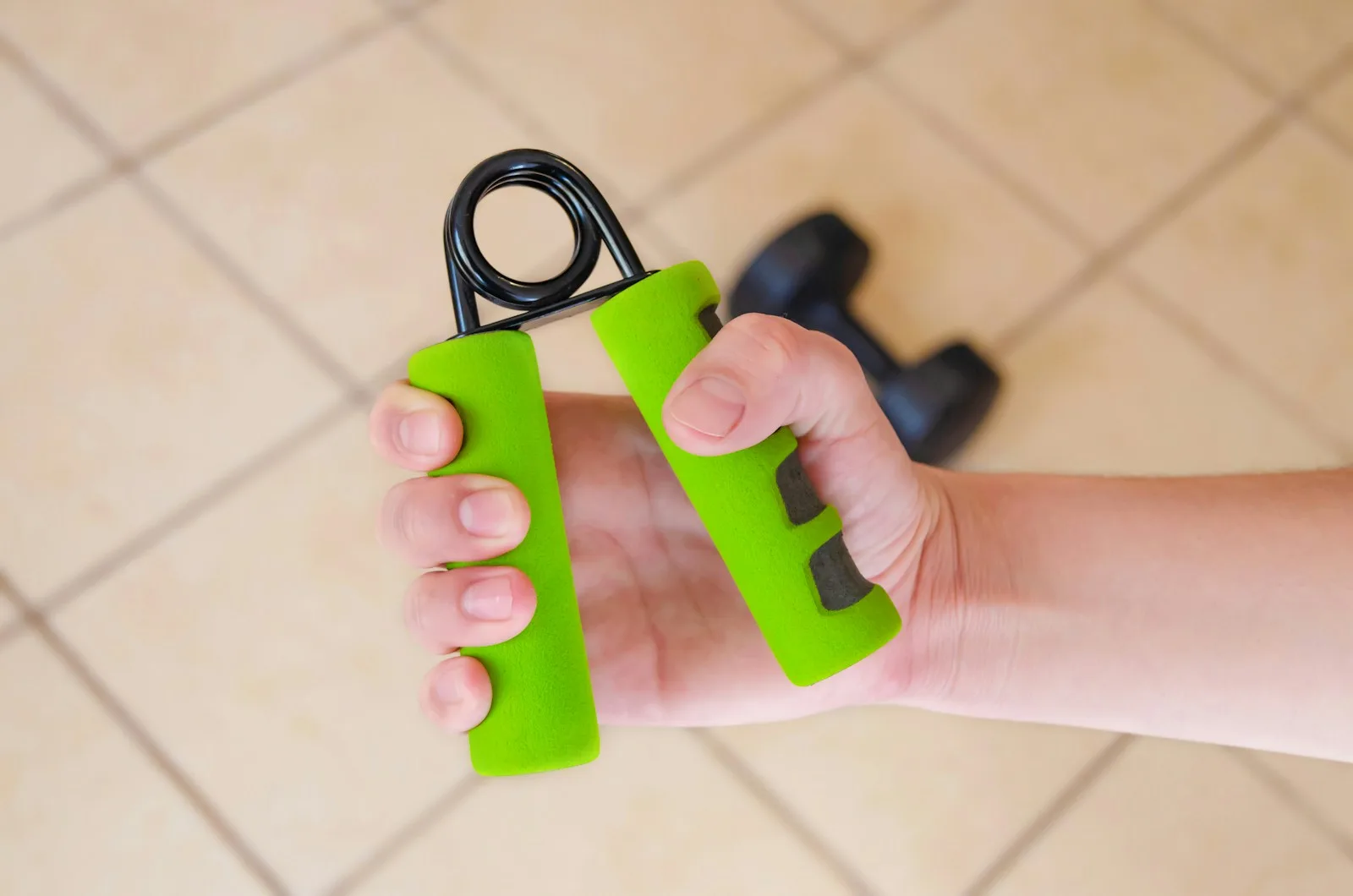
Squeezing a dynamometer for three seconds sounds trivial. Yet over the past decade, handgrip strength has emerged in the scientific literature as one of the most robust health markers a clinician can collect during a routine visit. In some studies, it predicts mortality better than systolic blood pressure. Here is what the research actually says — and what it does not.
A simple test, surprisingly accurate predictions
Handgrip strength is measured with a hand-held device called a dynamometer. The test takes a few seconds, requires no preparation, and costs almost nothing. That practicality is one of the reasons it has been embedded in some of the largest international cohorts of the last twenty years.
The most cited study in the field is the Prospective Urban Rural Epidemiology (PURE) study, published in The Lancet in 2015. It followed 139,691 adults across 17 countries of varying income levels for a median of four years. The headline finding, led by Darryl Leong and colleagues, is unambiguous: each 5-kg drop in grip strength was associated with a 16% increase in all-cause mortality (HR 1.16; 95% CI 1.13–1.20). Cardiovascular mortality rose by 17%, and the authors concluded that grip strength outperformed systolic blood pressure as a predictor of both endpoints.
Other work has reproduced the association. A 2018 meta-analysis published in the Journal of the American Medical Directors Association pooled prospective community cohorts and confirmed a clear inverse link between grip strength and all-cause mortality, cardiovascular mortality, and several cancers. More recently, an analysis of the NHANES 2011–2014 cohort in Scientific Reports (2024) confirmed a similar gradient in U.S. adults, independent of age, sex, and comorbidities.
Why such a basic test predicts so much
The idea that squeezing a tool for five seconds can reflect something as broad as mortality feels disproportionate. The underlying biology, however, is plausible. Grip strength acts as a proxy for overall muscle quality. Muscle mass and function decline with age, smoking, sedentary behaviour, several chronic diseases, and inflammatory states. A low grip strength condenses many of those signals into a single number.
A 2025 paper in Frontiers in Medicine examined the link between grip strength and biological markers of ageing — kidney function, inflammation, metabolism. The authors describe it as a plausible indicator of biological age, the functional age that may diverge from one's chronological age. Other recent work, including analyses of epigenetic age acceleration measured through DNA methylation, points the same way: lower grip strength is associated, on average, with a more advanced biological clock.
Grip strength is not magical. It is an aggregate. It captures a history of movement, inflammation, nutrition, and sometimes underlying disease. Conversely, it is also actionable: muscle is one of the few physiological parameters where training has a fast and measurable effect, even at advanced ages.
The clinical thresholds that matter
In geriatric practice, grip strength has become central to the diagnosis of sarcopenia, the progressive loss of muscle mass and strength. The European EWGSOP2 consensus, published in Age and Ageing in 2019, proposes operational cutoffs: grip strength below 27 kg in men and 16 kg in women suggests probable sarcopenia. These are lower than the 2010 cutoffs (30 and 20 kg), revised on the basis of more recent population data.
These thresholds are not absolute borders between health and disease. They mainly trigger further evaluation (muscle mass measurement, physical performance tests). The general public should not anchor on them: a young, trained adult will usually score well above them, and the most useful comparison is one's own trend over time.
The practical takeaway is to measure several times a year under stable conditions (same hand, same posture, ideally the same time of day) and to look at the trajectory. An unexplained sustained drop in an adult under 60 deserves a medical conversation, in the same spirit as a notable change in resting heart rate or body weight.
Improving grip strength: what works
The good news is that grip strength is trainable. It depends on forearm muscles and wrist coordination, but it also tracks overall upper-body strength. Three levers stand out in the literature.
- Regular resistance training of the major muscle groups (squats, deadlifts, rows, pull-ups) raises overall strength and, indirectly, grip.
- Targeted exercises: dead hangs from a bar, farmer carries (walking with heavy loads in each hand), pinch grip work, or hand grippers.
- Adequate protein intake, especially after 50, when muscle protein synthesis is less efficient. Geriatric guidance commonly cites 1 to 1.2 g/kg/day, to be adjusted with a clinician depending on kidney function and overall context.
Several trials show that even at advanced ages, a few weeks of structured training are enough to regain strength and function. Muscle remains a remarkably plastic tissue.
Putting strength in a wider picture
It is worth resisting the temptation to treat grip strength as a stand-alone score to chase. Like VO2 max, resting heart rate or heart rate variability, it only makes full sense inside a broader picture: sleep, nutrition, total physical activity, mental state. A low value means something different in someone recovering from a severe flu, in a chronically sedentary adult, and in an older person who walks little but is otherwise well.
That is the philosophy behind so-called quantified-self approaches: Kantise, for example, cross-references existing habits — health, sport, sleep, listening, gaming — to help see how those signals talk to each other, instead of pushing a single isolated score. A one-off grip measurement is not meant to alarm anyone; it has its place as one reference point inside a longitudinal reading of health. Readers who want to go deeper can find other articles on the blog covering VO2 max, zone-2 training, sleep or HRV from the same angle.
Grip strength is neither a magic test nor a gimmick. It is an aggregated, robust, low-cost marker, validated in cohorts of more than a hundred thousand people, and useful as long as it is read as part of a trajectory rather than against an anxious threshold. Its main practical virtue is that it is one of the rare biomarkers where you can both act directly and observe progress within weeks.
FAQ
Is grip strength really linked to longevity?
Yes. Several large prospective studies, including the PURE study on 139,691 adults (Lancet, 2015), show that lower grip strength is associated with higher all-cause and cardiovascular mortality. The correlation is robust, but it does not mean that mechanically increasing grip strength causes longer life on its own.
What grip strength is considered low?
The European EWGSOP2 consensus (2019) proposes thresholds of 27 kg in men and 16 kg in women to flag probable sarcopenia. Those values are not a diagnosis on their own; they trigger a more complete evaluation.
How can I measure my grip strength at home?
With a hand-held hydraulic or electronic dynamometer. To compare measurements over time, test the same hand, in the same posture, with three trials and keep the best score. The reference remains a calibrated test performed by a clinician.
How can I improve my grip strength?
Whole-body resistance training (squats, deadlifts, rows), dead hangs, farmer carries and adequate protein intake are the best-documented levers. Progress is measurable within weeks, including at advanced ages.
Does a low grip strength mean I will age badly?
No. A low value at a single point in time is a signal that invites further investigation, not a verdict. Strength is trainable, and trajectory matters more than an isolated number. A sustained, unexplained drop deserves a medical conversation.
Sources
- Leong D.P. et al., « Prognostic value of grip strength: findings from the Prospective Urban Rural Epidemiology (PURE) study », The Lancet, 2015.
- Cruz-Jentoft A.J. et al., « Sarcopenia: revised European consensus on definition and diagnosis (EWGSOP2) », Age and Ageing, 2019.
- « Comparison of grip strength measurements for predicting all-cause mortality among adults aged 20+ years from the NHANES 2011–2014 », Scientific Reports, 2024.
- « Handgrip strength as a potential indicator of aging », Frontiers in Medicine, 2025.
- « Association of Grip Strength With Risk of All-Cause Mortality, Cardiovascular Diseases, and Cancer: A Meta-analysis of Prospective Cohort Studies », JAMDA, 2018.
Kantise is a habit-observation app, not a medical device. The information in this article is for general informational purposes only and is not a substitute for professional medical advice.