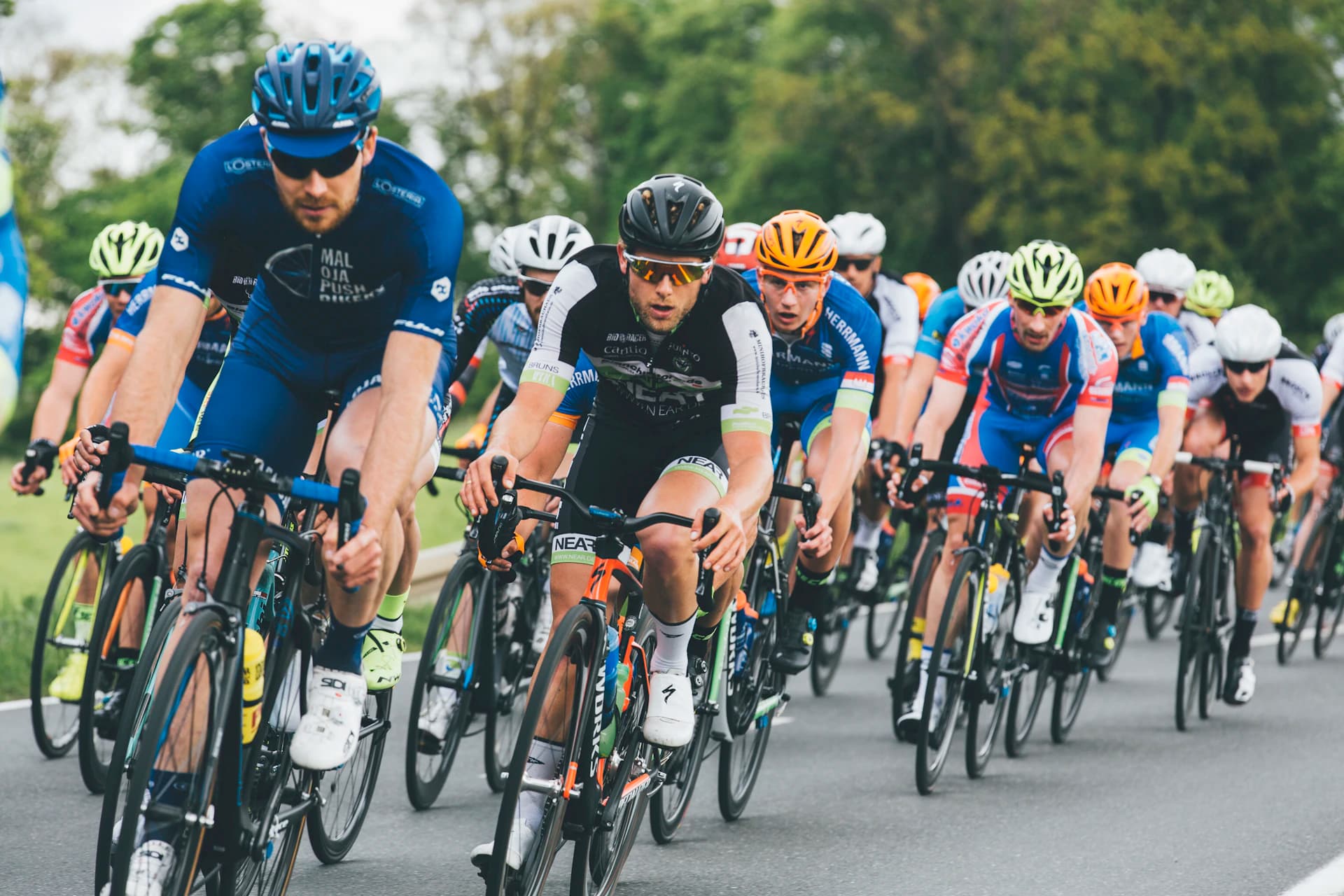
Every summer, the Tour de France turns country roads into an open-air laboratory. In this 2026 edition, raced under record heat, riders string together three weeks of effort that defy comprehension. Yet the most astonishing feat never appears on screen: it hides inside their chest. At rest, the hearts of some of these cyclists beat only around thirty times a minute — half as fast as a sedentary adult's. Far from a sign of weakness, this dramatic slowdown tells one of the finest stories of how the human body adapts to training.
A heart in slow motion: athletic bradycardia
In a healthy adult, the resting heart rate usually sits between 60 and 100 beats per minute. In endurance athletes, it collapses. The phenomenon has a name: athletic bradycardia — an abnormally slow heartbeat that, in their case, is nothing pathological.
A study published in late 2025 in the journal Circulation by Paolo D'Ambrosio's team offers the most precise measure of it to date. By continuously monitoring the heart rhythm of 465 endurance athletes (median age 23), the researchers found that 38% of them dropped to 40 beats per minute or fewer during sleep. In 2%, the heart slowed all the way to 30 beats per minute or below. A quarter of the athletes even showed brief cardiac pauses of two seconds or more, with no apparent consequences. The full detail appears in the original paper.
These figures, which would alarm a cardiologist facing a sedentary patient, are here the reflection of an organ deeply reshaped by years of effort.
The "athlete's heart": when endurance sculpts the organ
Under endurance training, the heart does not merely beat more slowly: it changes shape. Specialists speak of the "athlete's heart," a well-documented structural transformation that, in a healthy sportsperson, is entirely benign.
A landmark experiment led by Armin Arbab-Zadeh and published in 2014 in Circulation followed twelve sedentary adults through a year-long progressive program that ultimately prepared them to run a marathon. Imaging revealed a two-stage scenario. During the first six months of moderate effort, the left ventricle first thickens — so-called concentric hypertrophy. Then, as intensity rises, the chamber dilates: the ventricle grows larger and more supple, able to take in and eject a greater volume of blood with each contraction. This is eccentric hypertrophy, the signature of the endurance heart.
The result is an oversized pump. With each beat, it propels more blood. It therefore needs fewer beats to meet the same resting demands — hence the collapsed heart rate.
The Tour de France machine
The Tour served as an observation ground as early as the late 1990s. A pioneering study by Alejandro Lucía's team, published in 1999 in the International Journal of Sports Medicine, fitted eight professional riders with a heart rate monitor across the race's stages. These athletes posted an average maximal oxygen uptake (VO₂ max) of 74 ml/kg/min, a value that dwarfs that of an ordinary active adult, often between 35 and 45.
Another, more counterintuitive lesson: across the three weeks of racing, most of the time is spent at moderate intensity. The cyclists spent roughly 70% of their racing time below the first ventilatory threshold, 23% in the intermediate zone and only 7% at high intensity — most of that violent effort concentrated on time trials and the great mountain stages. The breakdown is laid out in Lucía and colleagues' publication. In other words, even the toughest endurance event on the calendar rests overwhelmingly on an aerobic base — the very base that, in training, reshapes the heart.
Why does the rhythm slow down so much?
For a long time, athletic bradycardia was attributed to a single factor: heightened tone of the vagus nerve, the nervous system's "brake" that calms the heart at rest. The reality is richer. The 2025 study emphasizes that the slowdown also stems from a remodeling of the sinus node itself — the heart's natural pacemaker — independent of nervous control. A genetic predisposition is thought to play a significant role too.
Three mechanisms therefore combine: a larger heart that ejects more blood per beat, a nervous system that applies a firmer brake at rest, and a pacemaker intrinsically slowed by training. Together, they explain how a Tour rider can live, away from effort, with a pulse that would make a non-athlete look like a patient to be watched.
Benign or dangerous?
The question is worth asking, because a rate of 30 beats per minute is, in an untrained person, an alarm signal that may reflect a cardiac conduction disorder. In the athlete, the context reverses the meaning of the number. The Circulation study followed its participants for more than five years: no serious complication arose among the athletes with the most extreme bradycardia. The authors conclude that, over the short and medium term, this slowdown is not associated with adverse outcomes.
The nuance, however, is essential. This reassuring finding applies to a healthy heart adapted by training. It does not mean that a very low pulse is always harmless. Symptoms — dizziness, fainting, unusual breathlessness, palpitations — should always prompt a medical visit, athlete or not. The "athlete's heart" is a diagnosis that only a physician, often aided by an electrocardiogram and an ultrasound, can make by ruling out pathological causes.

What cyclists' hearts teach the rest of us
You need not chase the yellow jersey to benefit from this cardiac plasticity. The remodeling seen in the pros is only an extreme version of a process open to everyone. Arbab-Zadeh's experiment showed it: twelve ordinary sedentary people watched their hearts transform in a single year. The resting heart rate that drifts downward over months of regular training is the visible sign, on your wrist, of that adaptation underway.
This is where tracking your own data comes into its own. Resting heart rate, measured each morning by a smartwatch or a connected ring, is one of the most reliable and simplest fitness markers to watch. A downward trend over several weeks often signals improving fitness; a sudden rise may betray fatigue, a lack of sleep or a brewing infection. But the number needs context: cross-referencing it with sleep, activity and stress is what gives it depth. That is precisely the approach championed by Kantise, which connects your physiological signals to turn raw numbers into readable trends. More science-based analyses await you on our blog, and a full overview of the approach on the homepage.
So this summer, watching the peloton stretch out on a climb, remember: behind the speed and the suffering, each rider carries a heart patiently rebuilt by effort. An organ whose apparent calm, at 30 beats per minute, is the most dazzling proof of a machine perfectly tuned.
FAQ
What is a professional cyclist's resting heart rate?
It often sits between 30 and 40 beats per minute, versus 60 to 100 for a sedentary adult. In a 2025 study of 465 endurance athletes, 38% dropped to 40 beats or fewer and 2% to 30 during sleep.
What is the "athlete's heart"?
It refers to the structural adaptations of the heart to endurance training: the left ventricle dilates and becomes more supple, increasing the volume of blood ejected with each beat. In a healthy athlete, this transformation is entirely benign.
Is a very low pulse dangerous?
In a trained athlete, bradycardia is generally not linked to problems: the 2025 study's follow-up of more than five years found no serious complications. In an untrained person, however, or alongside dizziness, fainting or breathlessness, a very low pulse warrants a medical consultation.
Why do athletes' hearts beat more slowly?
Three factors combine: a larger heart that ejects more blood per beat, a firmer nervous brake (the vagus nerve) at rest, and a remodeling of the sinus node, the heart's natural pacemaker, driven by training.
Can a beginner lower their resting heart rate?
Yes. An experiment showed that twelve sedentary adults watched their hearts remodel over a year of progressive endurance training. A resting rate that drifts down over the weeks is a visible sign of that adaptation.