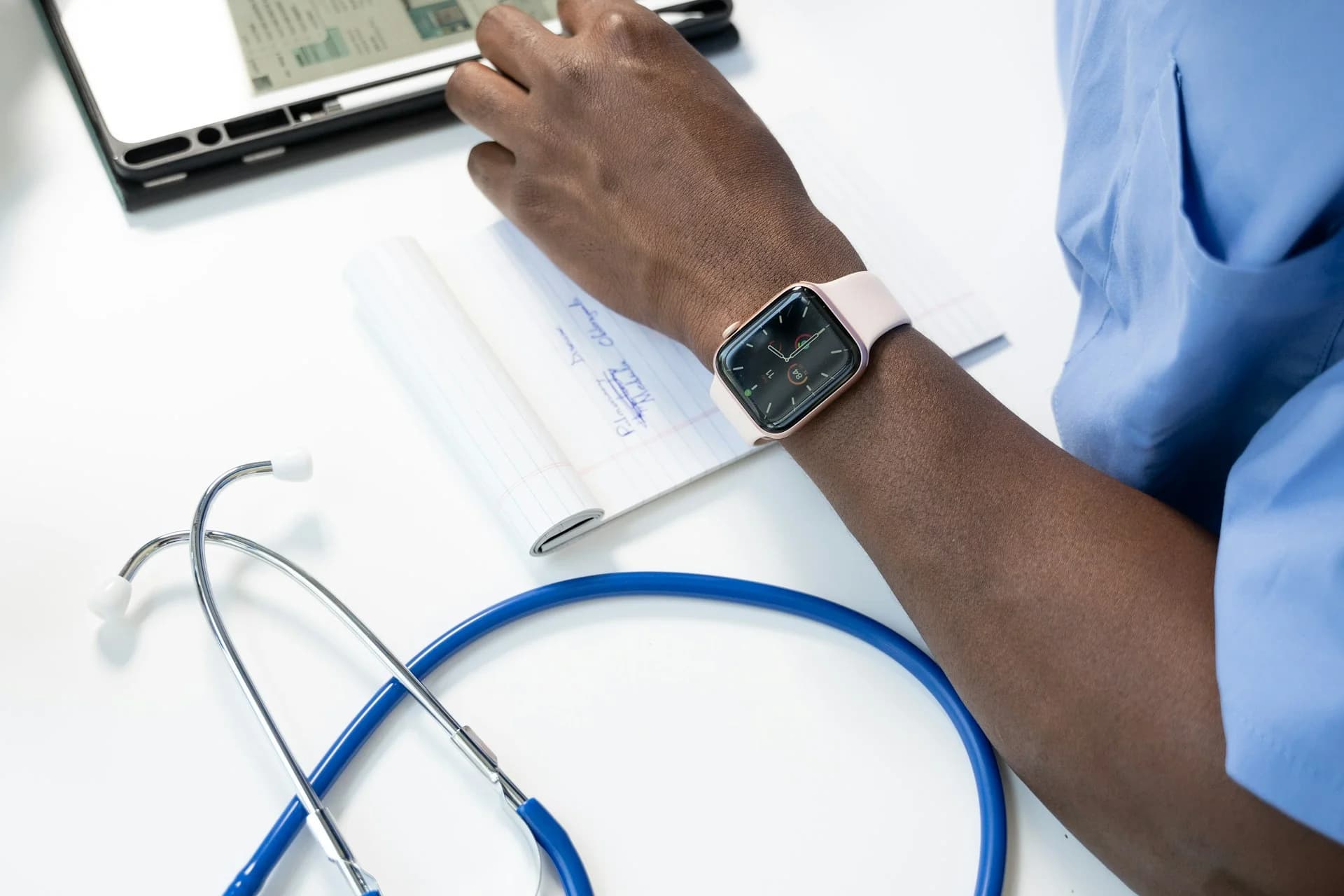
You hand your Apple Watch to your doctor. On the screen: weeks of sleep data, a heart rate variability curve, and an irregular rhythm episode flagged on a Thursday night. Your physician hesitates. What should they do with all of this?
This scene, increasingly common in medical offices, reflects a profound shift in our relationship with personal health. The wearable health technology market is now worth an estimated $100 billion globally. Smartwatches, smart rings, sleep trackers: never before have we generated this much physiological data about ourselves — yet the question of its clinical usefulness remains open, and the answers science is beginning to provide are both promising and nuanced.
What Your Tracker Can Actually Detect
Not all wearables are equal, and not all measured signals carry the same medical value. But several devices have demonstrated real detection capabilities for serious conditions.
The most documented example involves atrial fibrillation (AF) — a heart rhythm disorder that significantly increases stroke risk and affects millions of people who are unaware they have it. A meta-analysis published in January 2025 in JACC: Advances evaluated eleven studies covering 4,241 participants: the ECG built into the Apple Watch showed a sensitivity of 94.8% and a specificity of 95% for detecting this arrhythmia.
These figures carry real-world consequences. Dr. Lucy McBride, a primary care physician in Washington D.C. and author of Beyond the Prescription, describes a case where an Apple Watch detected dangerously low heart rates during a patient's sleep, leading to pacemaker placement she described as "potentially lifesaving." This kind of early detection — invisible during a routine office visit — illustrates the primary advantage of continuous monitoring.
Measurement Accuracy: What the Science Shows
Beyond one-off alerts, it is the continuous tracking of heart rate variability (HRV) that is drawing increasing interest from clinicians. HRV measures the variation in time between successive heartbeats — a recognized indicator of recovery status, physiological stress, and autonomic nervous system balance.
But how reliable are nocturnal HRV measurements from consumer devices? A study published in Physiological Reports in August 2025, led by Michael Dial and colleagues, compared five wearables across 536 nights of measurement using a clinical ECG as reference. The results reveal substantial variation in performance:
- Oura Gen 4: concordance coefficient of 0.99 (mean error 5.96%) — best result in the study
- Oura Gen 3: concordance of 0.97 (mean error 7.15%)
- WHOOP 4.0: concordance of 0.94
- Polar Grit X Pro: concordance of 0.82
These figures indicate that the best devices come very close to clinical measurements for nocturnal HRV. They also underscore that your choice of device directly influences the reliability of the data you present to your physician.
How to Use This Data With Your Doctor
In 2026, the American Academy of Neurology (AAN) published official guidance on integrating wearable data into clinical care. Dr. Sarah Benish, a neurologist at M Health Fairview in Minnesota and co-author of that guidance, emphasizes that smartwatches can help flag cardiac irregularities that raise stroke risk — but stresses a fundamental point: each device reports and analyzes data differently, and physicians need the patient's life context to interpret these metrics correctly.
Dr. McBride frames this principle plainly: "Data without context is just noise." Her advice to patients: don't arrive at an appointment with weeks of raw data, but instead identify patterns — an HRV that consistently drops after certain nights, sleep fragmentation during high-stress work periods. The physician then integrates those patterns into a broader assessment that includes medical history, lifestyle, and reported symptoms.
This approach has already surfaced useful insights for patients who engage actively with their data. Sophie Krupp, whose case was reported by NPR in April 2026, used an Oura Ring to identify her migraine triggers: by cross-referencing sleep quality data, skin temperature shifts, hormonal cycles, and alcohol consumption, she identified correlations that routine medical appointments had not uncovered.
The Blind Spot: Who Actually Protects Your Data?
Behind the medical promise of wearables lies a legal reality that few users are aware of: in the United States, HIPAA does not cover data generated by consumer wearable devices. Unlike your medical record, the data your smartwatch or smart ring produces receives far weaker legal protections — unless it is transmitted to a healthcare provider through a regulated, secure channel.
The situation varies considerably across manufacturers. A systematic analysis published in the Journal of Medical Internet Research in 2025 evaluated data-sharing practices across the major industry players. It identified Google/Fitbit as having "among the most permissive data-sharing terms." At the other end of the spectrum, Apple processes health data locally on the device with end-to-end encryption and does not use this data for advertising purposes. Oura states that it does not sell its users' personal data.
In Europe, the GDPR applies to health data and imposes stricter obligations on manufacturers who sell products in the EU. But the protection gap between medical records and wearable data remains significant in most countries. Before sharing your data with third-party apps or exporting it, it is worth reviewing your device's privacy policy.
Toward Data-Augmented Medicine
The rise of health wearables opens genuine possibilities: early detection of cardiac anomalies, monitoring of chronic conditions, and a deeper understanding of one's own biological rhythms. Quantified self tools that aggregate and cross-reference multiple data streams — health metrics, behavioral habits, activity patterns — can surface personal patterns that one-off appointments are not designed to capture.
But these data points remain indicators, not diagnoses. Their value is greatest when they inform a conversation with a healthcare professional who knows your full context and can interpret them against your medical history. Technology enriches the consultation. It does not replace it.
Frequently Asked Questions
Can my doctor officially use my wearable data?
Do all wearables measure HRV with the same accuracy?
Can the Apple Watch really detect atrial fibrillation?
Is my wearable data legally protected?
How should I prepare for a medical appointment with tracker data?
Which wearables share the least data with third parties?
Sources
- NPR / KPBS — Got wearable data? Your doctor can help you connect the dots, April 20, 2026. Read article
- Dial MB et al. — Validation of nocturnal resting heart rate and heart rate variability in consumer wearables. Physiological Reports, August 2025. Read study
- Meta-analysis — Diagnostic Accuracy of Apple Watch Electrocardiogram for Atrial Fibrillation. JACC: Advances, January 2025. Read study
- Systematic analysis — Wearable data privacy and data-sharing terms. Journal of Medical Internet Research, 2025.
Kantise is a habit-observation tool, not a medical device. The information in this article is for informational purposes only and does not replace the advice of a qualified healthcare professional.