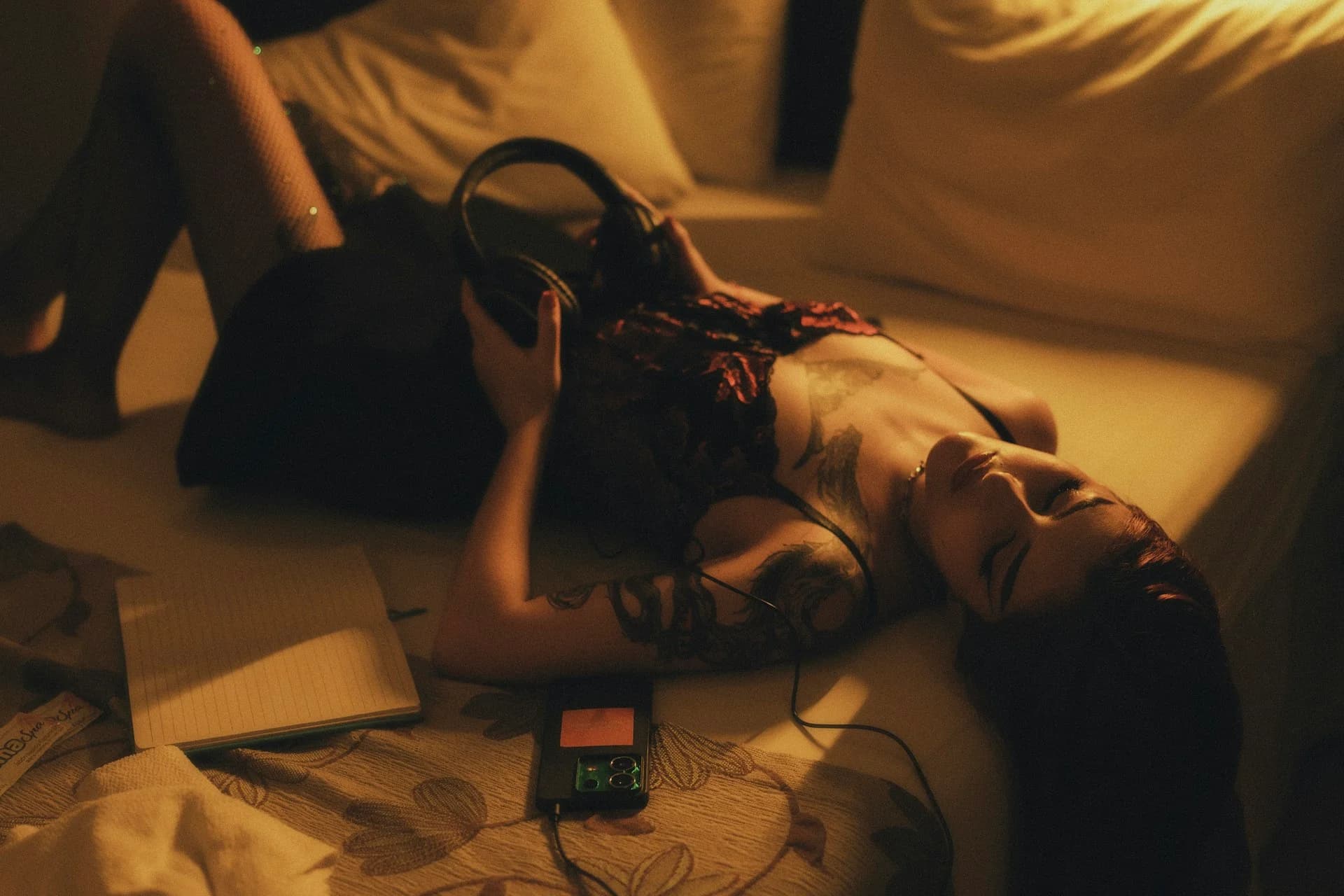
Do you fall asleep wearing headphones? You may have noticed that some evenings music pulls you into a deep sleep, while on others a melody loops relentlessly in your head until 3 a.m. That is not a coincidence. The relationship between music and sleep is far more complex — and more fascinating — than relaxation apps would have you believe.
Science has taken a serious look at the question in recent years. The conclusion: listening to music before bed can significantly improve sleep quality… or make it worse. Everything depends on what you listen to, when, and how.
What Research Says: Music as a Sleep Aid
The most recent comprehensive review on the topic, published in Frontiers in Neurology (2024), examined the impact of music therapy on sleep across diverse populations. The findings are encouraging: musical interventions consistently improve several key sleep indicators, including sleep onset latency, total sleep duration, and perceived sleep efficiency [1].
More specifically, a meta-analysis of 13 randomized controlled trials (1,007 total participants) found moderate-to-high certainty evidence that groups listening to music before sleep experienced better overall sleep quality than control groups [2].
The mechanisms researchers identified:
- Reduced sympathetic nervous system activity. Slow, gentle music activates the parasympathetic system, lowering heart rate and blood pressure — the ideal physiological conditions for falling asleep.
- Emotional regulation. A study in Scientific Reports (2019) demonstrated that relaxing music reduces cortisol levels (the stress hormone), facilitating the transition into deep sleep stages [3].
- Acoustic masking. Ambient music or nature sounds create a stable sonic background that dampens disruptive external noise.
The Optimal Dose: 30 to 45 Minutes, No More
Studies converge on an optimal "dosage": listening to relaxing music for 30 to 45 minutes before falling asleep, at a gentle volume. Researchers recommend maintaining this practice for at least 5 consecutive nights to observe measurable effects on sleep quality [2].
Musical characteristics identified as beneficial:
- Slow tempo (between 60 and 80 beats per minute, aligned with resting heart rate);
- Major or modal tonalities, avoiding dissonant harmonies;
- Constant volume without sudden variations;
- Instrumental music or minimal lyrics to limit cognitive engagement.
Some researchers also point to music tuned to 432 Hz — rather than the current standard of 440 Hz — as associated with shorter sleep onset latency and longer deep sleep stages. While evidence remains preliminary, interest in this practice is growing within the sleep research community [4].
The Paradoxical Effect: When Music Disrupts Sleep
Here is the angle that wellness apps leave off their landing pages. In 2021, a study published in Psychological Science by Michael K. Scullin and colleagues revealed a paradoxical effect: people who frequently listen to music before sleeping report more "nocturnal earworms" — melodies that loop in the mind at the moment of falling asleep — and objectively worse sleep quality [5].
A counterintuitive finding: in this study, instrumental music triggered more earworms than music with lyrics. Why? Researchers suggest that the brain, deprived of words to "complete" the song, works harder to reconstruct them — a cognitive activity that delays and disrupts sleep onset.
This paradox does not undermine the overall usefulness of music for sleep. It highlights the importance of selecting carefully what you listen to, and avoiding the habit of falling asleep to highly familiar, deeply memorized tracks.
Music, Spotify, and Your Nights: What Your Data Reveals
Evening music listening leaves traces in your Spotify data: genre, tempo, time of listening, session duration. Cross-referencing this data with your sleep metrics (time to fall asleep, perceived quality, nocturnal heart rate) allows you to answer very concrete questions:
- Do you sleep better on evenings when you listen to calm playlists rather than rock or electronic music?
- Is there an artist or genre that consistently appears in your worst nights?
- Does your listening session end well before you fall asleep, or do you continue listening throughout the night?
These questions seem mundane. But the answers, grounded in your own data, can transform your evening routine. Tools like Kantise allow you to connect your Spotify data with your health metrics to explore these personal correlations — no data science degree required.
Building an Effective Evening Music Routine
Here is what research suggests for making the most of music without disrupting your sleep:
1. Create a Dedicated Bedtime Playlist
Avoid algorithmic playlists that may string together tracks with varying tempos. Build a specific evening selection: 30 to 45 minutes of slow, gentle tracks that you know well enough to enjoy, but not so deeply that you can sing every note from memory.
2. Set a Sleep Timer
Falling asleep with music playing all night is not ideal. Program a 30–45 minute timer so music stops automatically after you drift off. Sound disturbances mid-sleep-cycle are more disruptive than no music at all.
3. Vary Your Playlists
To limit earworms, avoid listening to the same tracks every night. Rotate between different calm genres: slow classical, soft jazz, nature sounds, ambient electronic. Novelty reduces memorization and therefore the likelihood of nocturnal mental loops.
4. Mind the Timing
An intense music listening session at 11:30 p.m. — even soothing music — can sufficiently stimulate the auditory system to delay sleep onset. Start your musical ritual earlier, around 9:30–10 p.m., as part of a gradual wind-down toward sleep.
5. Test and Measure
Science gives you starting points, but your biology is unique. Test different approaches for a week each and note your perceived sleep quality and physiological data. What studies identify as beneficial on average may not match your individual profile.
To go further in analyzing your own listening and sleep data, explore the data cross-referencing features available, and browse other articles on the blog about the science of sleep and digital habits.
FAQ
What type of music is best for falling asleep?
Is it harmful to fall asleep to music every night?
Why does a song keep looping in my head when I try to fall asleep?
Can music help with chronic insomnia?
Does music volume affect how it impacts sleep?
Next time you open Spotify before bed, ask yourself: is this playlist actually helping me sleep, or is it simply playing a comforting background role? The answer may lie in your data. Discover how to cross-reference your listening habits and sleep metrics to find out.
Sources
- Li Y. et al., Meta-narrative review: the impact of music therapy on sleep and future research directions, Frontiers in Neurology, 2024. Link
- Jespersen K.V. et al., Listening to music for insomnia in adults, PMC NIH, 2022. Link
- Harmat L. et al., Effects of Relaxing Music on Healthy Sleep, Scientific Reports, 2019. Link
- Calamassi D. & Pomponi G.P., Music Tuned to 440 Hz Versus 432 Hz and the Health Effects, Explore, 2019.
- Scullin M.K. et al., Bedtime Music, Involuntary Musical Imagery, and Sleep, Psychological Science, 2021. Link
Kantise is an observation tool for your habits, not a medical device. The information in this article is for educational purposes only and does not replace professional medical advice. If you experience persistent sleep disorders, consult a doctor.